VLADA REPUBLIKE HRVATSKE
115
Na temelju članka 30. stavka 1. Zakona o sklapanju i izvršavanju međunarodnih ugovora (»Narodne novine«, broj 28/96), Vlada Republike Hrvatske je na sjednici održanoj 29. studenoga 2012. godine donijela
UREDBU
O OBJAVI SPORAZUMA O FINANCIRANJU IZMEĐU VLADE REPUBLIKE HRVATSKE I EUROPSKE KOMISIJE KOJI SE ODNOSI NA VIŠEKORISNIČKI PROGRAM ZA NUKLEARNU SIGURNOST I ZAŠTITU OD ZRAČENJA U OKVIRU INSTRUMENTA PRETPRISTUPNE POMOĆI ZA 2011. GODINU (CENTRALIZIRANO UPRAVLJANJE)
Članak 1.
Objavljuje se Sporazum o financiranju između Vlade Republike Hrvatske i Europske komisije koji se odnosi na Višekorisnički program za nuklearnu sigurnost i zaštitu od zračenja u okviru Instrumenta pretpristupne pomoći za 2011. godinu (centralizirano upravljanje), potpisan u Bruxellesu, 24. svibnja 2012. godine i u Zagrebu, 25. rujna 2012. godine, u izvorniku na engleskom jeziku.
Članak 2.
Tekst Sporazuma o financiranju iz članka 1. ove Uredbe, u izvorniku na engleskom jeziku i u prijevodu na hrvatski jezik, glasi:
FINANCING AGREEMENT BETWEEN THE GOVERNMENT OF THE REPUBLIC OF CROATIA AND THE EUROPEAN COMMISSION CONCERNING THE HORIZONTAL PROGRAMME ON NUCLEAR SAFETY AND RADIATION PROTECTION UNDER THE INSTRUMENT FOR PRE-ACCESSION ASSISTANCE FOR THE YEAR 2011
(Centralised Management)*
FINANCING AGREEMENT
THE GOVERNMENT OF THE REPUBLIC OF CROATIA
and
THE EUROPEAN COMMISSION
hereafter jointly referred to as «the Parties», or individually as «the Beneficiary» in the case of the Government of the Republic of Croatia, or »the Commission», in the case of the European Commission.
Whereas:
(a) On 1 August 2006, the Council of the European Union adopted Regulation(EC) No 1085/2006 establishing an instrument for pre-accession assistance (hereafter: the «IPA Framework Regulation»). With effect from 1 January 2007, this instrument constitutes the single legal basis for the provision of financial assistance to candidate countries and potential candidates in their efforts to enhance political, economic and institutional reforms with a view to their eventually becoming members of the European Union.
(b) On 12 June 2007, the Commission adopted Regulation (EC) No 718/2007 implementing the IPA Framework Regulation, detailing applicable management and control provisions (hereafter: the «IPA Implementing Regulation»).
(c) European Union assistance under the instrument for pre-accession assistance should continue to support the beneficiary countries in their efforts to strengthen democratic institutions and the rule of law, reform public administration, carry out economic reforms, respect human as well as minority rights, promote gender equality, support the development of civil society and advance regional cooperation as well as reconciliation and reconstruction, and contribute to sustainable development and poverty reduction.
European Union assistance for candidate countries should additionally focus on the adoption and implementation of the full EU acquis, and in particular prepare them for the implementation of the European Union’s agricultural and cohesion policy.
(d) The Parties have concluded on 27 August 2007 a Framework Agreement setting out the general rules for cooperation and implementation of the European Union assistance under the Instrument for Pre-accession Assistance.
(e) The Commission adopted on 11 November 2011 the Horizontal programme on Nuclear Safety and Radiation Protection under the IPA Transition Assistance and Institution Building Component for the year 2011 (hereafter: »the programme»). Part of this programme concerning the Republic of Croatia is to be implemented by the Commission on a centralised basis.
(f) It is necessary for the implementation of this programme that the Parties conclude a Financing Agreement to lay down the conditions for the delivery of European Union assistance, the rules and procedures concerning disbursement related to such assistance and the terms on which the assistance will be managed.
HAVE AGREED ON THE FOLLOWING:
1 THE PROGRAMME
The Commission will contribute, by way of grant, to the financing of the following programme, which is set out in Annex A to this Agreement:
Programme number: CRIS Nº 2011/023-384, 2011/023-388 and 2011/023-389
Title: Horizontal programme on Nuclear Safety and Radiation Protection under the IPA Transition Assistance and Institution Building Component for the year 2011 – C(2011)8164 of 11 November 2011.
The part of this programme concerning the Republic of Croatia to be implemented by centralised management includes one administrative arrangement with the Joint Research Centre – Institute for Energy (Petten), namely:
Project No 6: »Technical back-up to the IPA horizontal programme on nuclear safety and radiation protection».
2 IMPLEMENTATION OF THE PROGRAMME
(1) The part of this programme specified under »Heading 1 – The programme», concerning the Republic of Croatia shall be implemented by the Commission on a centralised basis, in the meaning of Article 53a of Council Regulation (EC Euratom) No 1605/2002 on the Financial Regulation applicable to the general budget of the European Communities, as last modified by Regulation (EC)1525/2007 of 17 December 2007 (hereafter: «Financial Regulation»).
(2) The programme shall be implemented in accordance with the provisions of the Framework Agreement on the Rules for co-operation concerning EU Financial Assistance to the Republic of Croatia and the implementation of the Assistance under the Instrument for Pre-accession Assistance (IPA) concluded between the Parties on 27 August 2007 (hereafter: «the Framework Agreement»), which is set out in Annex B to this Agreement.
3 STRUCTURES AND AUTHORITIES WITH RESPONSIBILITIES
(1) The Beneficiary shall designate a national IPA co-ordinator, in accordance with the Framework Agreement, who shall act as the representative of the Beneficiary vis-à-vis the Commission. He/she shall ensure that a close link is maintained between the Commission and the Beneficiary with regard both to the general accession process and to EU pre-accession assistance under IPA.
4 FUNDING
The funding for the implementation of this Agreement shall be as follows:
(a) The European Union contribution for the total of the programme for the year 2011 is fixed at a maximum of EUR 4 613 750, as detailed in the programme. However, payment of the European Union contribution by the Commission shall be made within the limits of the funds available.
(b) The cost of the structures and authorities put in place by the Beneficiary for the implementation of this programme shall be borne by the Beneficiary.
5 CONTRACTING DEADLINE
(1) The individual contracts and agreements which implement this Agreement shall be concluded no later than three years from the date of conclusion of this Agreement.
(2) Any funds for which no contract has been concluded before the contracting deadline shall be cancelled.
6 DEADLINE FOR THE EXECUTION OF CONTRACTS
(1) The contracts must be executed within a maximum of two years from the end date of contracting.
(2) The deadline for the execution of contracts may be extended before its end date in duly justified cases.
7 DISBURSEMENT DEADLINE
(1) Disbursement of funds must be made no later than one year after the final date for the execution of contracts.
(2) The deadline for disbursement of funds may be extended before its end date in duly justified cases.
8 TREATMENT OF RECEIPTS
(1) Receipts for the purposes of IPA include revenue earned by an operation, during the period of its co-financing, from sales, rentals, service enrolment/fees or other equivalent receipts with the exception of:
(a) receipts generated through the economic lifetime of the co-financed investments in the case of investments in firms;
(b) receipts generated within the framework of a financial engineering measure, including venture capital and loan funds, guarantee funds, leasing;
(c) where applicable, contributions from the private sector to the co-financing of operations, which shall be shown alongside public contribution in the financing tables of the programme.
(2) Receipts as defined in paragraph 1 above represent income which shall be deducted from the amount of eligible expenditure for the operation concerned. No later than the closure of the programme, such receipts shall be deducted from the relevant operation’s eligibility expenditure in their entirety or pro-rata, depending on whether they were generated entirely or only in part by the co-financed operation.
9 ELIGIBILITY OF EXPENDITURE
(1) Expenditure under the programme in Annex A shall be eligible for European Union contribution if it has been incurred after the contracts and grants implementing such programme have been signed, except in the cases explicitly provided for in the Financial Regulation.
(2) The following expenditure shall not be eligible for European Union contribution under the programme in Annex A:
(a) taxes, including value added taxes;
(b) customs and import duties, or any other charges;
(c) purchase, rent or leasing of land and existing buildings;
(d) fines, financial penalties and expenses of litigation;
(e) operating costs;
(f) second hand equipment;
(g) bank charges, costs of guarantees and similar charges;
(h) conversion costs, charges and exchange losses associated with any of the component specific euro accounts, as well as other purely financial expenses;
(i) contributions in kind;
(j) any leasing costs;
(k) depreciation costs.
(3) By way of derogation from paragraph 2 above, the Commission will decide on a case-by-case basis whether the following expenditure is eligible:
(a) operating costs, including rental costs, exclusively related to the period of co-financing of the operation;
(b) value added taxes, if the following conditions are fulfilled:
(i) the value added taxes are not recoverable by any means;
(ii) it is established that they are borne by the final beneficiary, and
(iii) they are clearly identified in the project proposal.
(c) costs relating to a bank guarantee or comparable surety to be lodged by the final beneficiary of a grant.
(4) Expenditure financed under IPA shall not be the subject of any other financing under the European Union budget.
10 RETENTION OF DOCUMENTS
(1) All documents relating to the programme in Annex A shall be kept for at least five years from the date on which the European Parliament grants discharge for the budgetary year to which the document relate.
(2) In the case that the programme in Annex A is not definitely closed within the deadline set in paragraph 1 above, the documents relating to it shall be kept until the end of the year following that in which the programme in Annex A is closed.
11 ROADMAP FOR DECENTRALISATION WITHOUT EX-ANTE CONTROLS
(1) The Beneficiary shall establish a detailed roadmap with indicative benchmarks and time limits to achieve decentralisation with ex ante controls by the Commission. In addition, the Beneficiary shall establish an indicative roadmap to achieve decentralisation without ex ante controls by the Commission.
(2) The Commission shall monitor the implementation of the roadmaps mentioned in paragraph 1, and shall take due account of the results achieved by the Beneficiary in this context, in particular in the provision of assistance. The roadmap to achieve decentralization without ex ante controls may refer to a phased waiver of different types of ex-ante control.
(3) The Beneficiary shall keep the Commission regularly updated with the progress made in the implementation of this roadmap.
12 INTERPRETATION
(1)Subject to any express provision to the contrary in this Agreement, the terms used in this Agreement shall bear the same meaning as attributed to them in the IPA Framework Regulation and the IPA Implementing Regulation.
(2) Subject to any express provision to the contrary in this Agreement, references to this Agreement are references to such Agreement as amended, supplemented or replaced from time to time.
(3) Any references to Council or Commission Regulations are made to the version of those regulations as indicated. If required, modifications of these regulations shall be transposed into this Agreement by means of amendments.
(4) Headings in this Agreement have no legal significance and do not affect its interpretation.
13 PARTIAL INVALIDITY AND UNINTENTIONAL GAPS
(1) If a provision of this Agreement is or becomes invalid or if this Agreement contains unintentional gaps, this will not affect the validity of the other provisions of this Agreement. The Parties will replace any invalid provision by a valid provision which comes as close as possible to the purpose of and intent of the invalid provision.
(2) The Parties will fill any unintentional gap by a provision which best suits the purpose and intent of this Agreement, in compliance with the IPA Framework Regulation and the IPA Implementing Regulation.
14 REVIEW AND AMENDMENTS
(1) The implementation of this Agreement will be subject to periodic reviews at times arranged between the Parties.
(2) Any amendment agreed to by the Parties will be in writing and will form part of this Agreement. Such amendment shall come into effect on the date determined by the Parties.
15 TERMINATION
(1) Without prejudice to paragraph 2, this Agreement shall terminate eight years after its signature. This termination shall not preclude the possibility for the Commission making financial corrections in accordance with Article 56 of the IPA Implementing Regulation.
(2) This Agreement may be terminated by either Party by giving written notice to the other Party. Such termination shall take effect six calendar months from the date of the written notice.
16 SETTLEMENT OF DIFFERENCES
(1) Differences arising out of the interpretation, operation and implementation of this Agreement, at any and all levels of participation, will be settled amicably through consultation between the Parties.
(2) In default of amicable settlement, either Party may refer the matter to arbitration in accordance with the Permanent Court of Arbitration Optional Rules for Arbitration Involving International Organisations and States in force at the date of this Agreement.
(3) The language to be used in the arbitration proceedings shall be English. The appointing authority shall be the Secretary General of the Permanent Court of Arbitration following a written request submitted by either Party. The Arbitrator’s decision shall be binding on all Parties and there shall be no appeal.
17 NOTICES
(1) Any communication in connection with this Agreement shall be made in writing and in the English language. Each communication must be signed and must be supplied as an original document or by fax.
(2) Any communication in connection with this Agreement must be sent to the following addresses:
For the Commission:
Mr Gerhard Schumann-Hitzler
Director
Directorate General for Enlargement
Financial Instruments & Regional Programmes
CHAR 04/99
B-1049 Brussels
Fax: +32 2 2957502
For the Beneficiary
Mr Matija Derk
National IPA Co-ordinator
Assistant Minister of Regional Development and EU Funds
Ministry of Regional Development and EU Funds
Trg kralja Petra Krešimira IV br. 1
10000 Zagreb
Croatia
18 NUMBER OF ORIGINALS
This Agreement is drawn up in duplicate in the English language.
19 ANNEXES
The Annexes A and B shall form an integral part of this Agreement.
20 ENTRY INTO FORCE
This Agreement shall enter into force on the date on which the Recipient notifies the Commission that all internal procedures in the Republic of Croatia necessary for the entry into force of this Agreement have been fulfilled.
Signed, for and on behalf of the Government of the Republic of Croatia, at Zagreb, on 25 September 2012
by Mr Matija Derk
National IPA Co-ordinator
Assistant Minister of Regional Development and EU Funds
Signed, for and on behalf of the Commission, at Brussels, on 24 May 2012
by Mr Gerhard Schumann-Hitzler
Director
HORIZONTAL PROGRAMME ON NUCLEAR SAFETY AND RADIATION PROTECTION UNDER THE IPA TRANSITION ASSISTANCE AND INSTITUTION BUILDING COMPONENT FOR THE YEAR 2011 ADOPTED BY COMMISSION DECISION C(2011)8164 OF 11 NOVEMBER 2011
ANNEX A: Horizontal Programme on Nuclear Safety and Radiation Protection under the IPA-Transition Assistance and Institution Building Component for the year 2011
1 IDENTIFICATION
2. THE PROGRAMME
2.a Priorities selected under this programme
The IPA horizontal programme on nuclear safety and radiation protection is implemented in the context of the priorities for IPA support covered under sector 5 – Transport and energy infrastructure, including nuclear safety which have been identified in the IPA Multi-Beneficiary Multi-annual Indicative Planning Document (MIPD) for the years 2011-2013.
As mentioned in the Multi-Beneficiary MIPD «in the area of nuclear safety and radiation protection, full transposition of the EU acquis remains an objective for most of the IPA Beneficiaries. This transposition would require the full operation of the national regulatory bodies which, for some of them, has not yet been accomplished.
In addition, there are a number of issues that need to be addressed in all Beneficiaries such as the establishment of an appropriate regulatory framework, the reduction of medical or occupational exposure and the radioactive contamination of the environment (including by depleted uranium).
Much remains to be done also for emergency preparedness and early warning systems, training of personnel confronted with ionising radiation and public information. The prevention of illicit trafficking of nuclear materials and radiation sources as well as the management of radioactive waste (including radioactive lightning rods) and the storage in licensed facilities remains a major concern.
All these issues may require funding for supplying equipment, providing technical assistance and possibly carrying out works.
It should be pointed out that for Serbia, which has operated nuclear research reactors in the past, specific actions must be undertaken in order to decommission these reactors according to best EU practices. In this regard, security of radioactive sources and fissile materials should be treated as an issue of highest importance.
Two Beneficiaries (Turkey and Albania) have declared their intention to eventually construct nuclear power plants. In those cases, particular attention should be paid to ensure that all provisions, especially those regarding safety and security, comply with international conventions, with the IAEA Safety Standards, with international (including bilateral) agreements and the EU acquis.
The actions foreseen under this sector will aim at achieving the following:
(1) Technical capacity of the national regulatory agencies enhanced to comply with EU acquis and regulations on nuclear safety and radiation protection.
(2) Further contribution to the development of emergency plans and strengthening of capacity for emergency preparedness and response in several Beneficiaries.
(3) Implementation of monitoring programmes for measuring the occurrence of radioactivity in the environment and establishing of methodologies for public dose assessment.
(4) Actions to decrease occupational and patients’ exposure in the medical sector.
(5) Public awareness campaigns run and early warning systems established.
This programme focuses on a set of two regional projects, and three national projects that are covering the Multi-Beneficiary MIPD priorities and addressing a number of issues, i.e. approximation of the legislations/regulations with the EU acquis in the field of nuclear safety and radiation protection, enhancement of the technical capacity of the national nuclear regulatory bodies and their Technical Support Organisations, monitoring of the radioactivity in the environment, emergency preparedness, reduction of medical exposure. In addition the programme includes one administrative arrangement with the Joint Research Centre – Institute for Energy (Petten) that should provide the necessary technical back-up to DG Enlargement to launch, monitor and evaluate the results of all these projects.
2.b Past assistance, lessons learned and donor coordination in the sector nuclear safety and radiation protection
With the exception of Kosovo, all Beneficiaries have established nuclear regulatory bodies during the last few years. Although one 2008 IPA-funded regional project is being performed in order to enhance the regulatory infrastructure and to assess the degree of transposition of the EU acquis, this action appears quite insufficient to align the legislation and regulations of all Beneficiaries with the EU acquis. Further regulatory assistance in order to enhance the technical capacity of the regulatory bodies and wherever possible their Technical Support Organisations (TSOs) is needed and this is precisely the main aim of this programme which focuses on Albania, Bosnia and Herzegovina, the former Yugoslav Republic of Macedonia, Montenegro, Serbia, as well as Kosovo.
As part of the enhancement of the technical capacity of the TSO in the field of medical exposure and monitoring of the radioactivity in the environment, it is considered worthwhile to support a Montenegrin organisation named CETI through the delivery of equipment. Actually this project takes over a former 2008 IPA-funded project for which – for various reasons – the tendering procedure failed.
Croatia is now close to accession to the EU and its regulatory framework is in line with the EU acquis. However the implementation of the regulations needs further support in two specific domains: emergency preparedness and monitoring of the radioactivity in the environment. Both domains were identified as priority in the IPA-funded assessment study on the regulatory infrastructure that was concluded in 2010. They are also clearly identified as priority domains in the Multi-Beneficiary MIPD.
This programme constitutes a logical continuation of the past and running IPA-funded projects. It should help to solve most of the outstanding radiological issues in the Western Balkans by 2015-2016.
It is important to underline that all these projects are part of a coherent strategy for external assistance to the Western Balkans in the nuclear domain that was drawn up together with each Beneficiary in 2010 and 2011. This strategy sets out in detail the needs for external assistance, supply of equipment and works until 2015-2016. The IAEA has been associated to the drafting of the corresponding roadmaps until 2013.
Although in the recent past, most emphasis of the IPA horizontal programme was placed on tackling the Vinča nuclear issues and in particular on the repatriation of the Serbian spent nuclear fuel to the Russian Federation, it was decided to put on hold the support for at least one year due to the delays that were recorded in the implementation of IPA-funded projects on radioactive waste management at Vinča. However, it is worth highlighting the successful repatriation project which absorbed approximately one third of the resources of this programme over the years 2007 – 2010.
All projects directly connected with technical assistance to the Western Balkans are closely coordinated with the IAEA.
Since 2007 the IPA horizontal programme on nuclear safety and radiation protection is providing the Western Balkans with a significant support in order to solve a number of important nuclear and radiological issues. Although some political problems somewhat delayed the implementation of these successive programmes, in particular concerning the rather late establishment of nuclear regulatory bodies in some of the Beneficiaries, the overall appraisal of past and on going assistance is very positive.
The lessons learnt mainly concern the insufficient involvement of the beneficiary organisations of these programmes in the tendering procedures for contracting. Most of them – including Croatia – need technical support from DG Enlargement and the JRC-Petten so that Terms of Reference are detailed enough and neutral. This led to late contracting for most of the projects. Another important lesson is that improvement of the regulatory infrastructure in each of the Beneficiaries faces political difficulties. Most of the regulatory bodies are not in line with their sister organisations in the EU and their further alignment is very difficult to achieve. A third lesson is that licensing of storage facilities for radioactive waste – which is a key-issue in nuclear safety – experienced many difficulties again for political reasons. Also,, the implementation of projects in joint management with the IAEA proved to be a rather complex task due to the high turn-over of staff within the IAEA and the different policies followed for technical assistance. Anyway the coordination is performed through regular contacts with the IAEA and joint missions in the Beneficiaries of concern.
Coherence of approach with the Instrument for Nuclear Safety Cooperation (INSC) is ensured through close contacts and exchange of information with the members of the INSC Committee.
2.c Description
Project No 1: «Further enhancement of the technical capacity of nuclear regulatory bodies in Bosnia and Herzegovina and Montenegro« aims at providing a direct support to the nuclear regulatory bodies of Bosnia and Herzegovina and Montenegro to further contribute to the transposition of the EU acquis in the field of nuclear safety and radiation protection, and to align their functioning with their sister organisations in the EU.
This project covers two Beneficiaries of the Western Balkans for which the needs for regulatory assistance are currently similar. The project will mainly aim at finalising the transposition of the EU acquis into the national legislation and regulations, at defining implementing procedures for regulations, at reducing medical exposure, at improving dosimetry control, at delivering some equipment in particular for Quality Assurance/Quality Control (QA/QC) in diagnostic radiology, at reviewing national emergency plans and at contributing to the setting-up of public information campaigns.
Enhancement of the technical capacity of the national regulatory bodies in the nuclear area is fully compliant with the basic objectives of the Multi-Beneficiary MIPD.
Due to the fact that the IAEA is currently implementing a number of projects in the field of regulatory assistance in Bosnia and Herzegovina as well as in Montenegro, and that this assistance will continue over the next years, it is considered worthwhile to implement this project in joint management with the IAEA. In this way, risks of duplication of external assistance will be avoided and synergies can be developed.
A contribution agreement with the IAEA for an amount of EUR
850 000 will be concluded in Q2 2013 for the implementation of this project in accordance with the terms of the Financial and Administrative Framework Agreement (FAFA) between the European Union and the United Nations, signed on 29 April 2003, to which the IAEA adhered on 17 September 2004.
Project No 2: «Further enhancement of the technical capacity of nuclear regulatory bodies in Albania, the former Yugoslav Republic of Macedonia, Serbia, as well as Kosovo« aims at providing a direct support to the nuclear regulatory bodies of the Beneficiaries to further contribute to the transposition of the EU acquis in the field of nuclear safety and radiation protection, and to align their functioning with their sister organisations in the EU.
This is a regional project in scope. It will aim at enhancing the technical capacity of the regulatory bodies of the Beneficiaries in the field of nuclear safety and radiation protection and therefore is fully compliant with the MIPD’s objectives. Many regulatory topics should be addressed within the framework of this project e.g. finalisation of the transposition of the EU acquis into the national legislation and regulations in Serbia and Kosovo; definition of criteria to establish TSOs to the national regulatory bodies in Albania, establishment of Quality Management System in Albania and Serbia; establishment of QA/QC procedures in the medical sector in the former Yugoslav Republic of Macedonia; reviewing of response plans in case of a radiological emergency in Albania; drawing-up of a national strategy for radioactive waste management and decommissioning activities in Serbia.
Despite the fact that similar activities are being supported by the IAEA, it has not been possible to reach an agreement with the Agency regarding the implementation of this project in joint management. Therefore a close coordination with IAEA activities will be required in order to avoid any overlapping.
One service contract for an amount of EUR 2.1 million and one supply contract for an amount of EUR 200 000 will be concluded following two calls for tenders that will be launched in the second quarter of 2013 and in the fourth quarter of 2014, respectively.
Project No 3: «Strengthening Radiation Protection and Nuclear Safety in Montenegro through Capability Upgrading of Technical Support Institution« is a supply project with aims at providing various types of equipment to upgrade the technical capabilities of the Centre for Ecotoxicological Research of Montenegro (CETI) that is acting as TSO to the Montenegrin regulatory body. The areas covered by this supply project are: monitoring of the radioactivity in the environment, including response to radiological/nuclear emergency situations, management of low and medium radioactivity, radioactive waste storage and transportation of radioactive materials, professional, patient, public and environmental exposure control and Quality assurance/Quality control (QA/QC) of medical radiation source.
The Multi-Beneficiary MIPD specifies that actions should be undertaken on the development of emergency plans and strengthening of capacity for emergency preparedness and response in all Beneficiaries, the implementation of monitoring programmes for measuring the occurrence of radioactivity in the environment and establishing of methodologies for public dose assessment, and actions to decrease occupational and patients’ exposure in the medical and industrial sectors. All these issues may require funding for supplying equipment, providing technical assistance and possibly carrying out works.
The project will be implemented through one to four supply contracts for a total amount of EUR 300 000 that will be concluded following a call for tenders (4 lots) launched in the first quarter of 2012. Additional supply contracts for an estimated amount of EUR 95 000 fully financed by the beneficiary organization will be concluded by CETI following a call for tenders to be launched in the first quarter of 2012 (parallel co-financing) by the beneficiary organisation.
Project No 4: «Upgrading of the emergency preparedness system in the Republic of Croatia« provides support to the State Office for Radiological and Nuclear Safety in Croatia mainly to harmonize radiological emergency response procedures with neighbouring countries, in particular with Slovenia and Hungary. It also aims at upgrading the national radiological emergency response capabilities to face incidents and accidents of different levels, as well as the national emergency plan that will enable rapid implementation of protective measures within the first few hours and in the days after the accident through a coordinated response of the emergency services and other agencies.
The Multi-Beneficiary MIPD’s objectives include an action on emergency preparedness and therefore this project is fully compliant.
The following two contracts are expected to be concluded to implement this project: one service contract for an EU contribution of EUR 171 000 following a call for tenders launched in the third quarter of 2012 (a national co-financing is foreseen for an amount of EUR 19 000); and one supply contract for an EU contribution of EUR 263 500 following a call for tender launched in the fourth quarter of 2013 (a national co-financing is foreseen for an amount of EUR 46 500).
The implementation of this project will be decentralised.
Project No 5: «Upgrading the systems for the on- and off-line monitoring of radioactivity in environment in Croatia in regular and emergency situations». The project focuses on the upgrading of the system for on- and off-line monitoring of the environment in the Republic of Croatia necessary to comply with the Article 35 of the Euratom Treaty under regular and emergency situations, and in particular, ambient dose rate network, on-line monitoring in surface waters, off-line monitoring and mobile systems. It consists of two components: component 1 for the purchase, installation and commissioning of additional equipment for upgrading the existing technical infrastructure; and component 2 for the verification of existing gamma dose rate (GDR) stations regarding standard site criteria and generation of corrective/deviation factors if needed to standardize GDR station measurements with EU requirements for environmental monitoring.
The project responds to some of the conclusions of IPA 2007 Project «Assessment of the needs and proposed actions in order to perform the monitoring of the radioactivity in the environment in Albania, Bosnia and Herzegovina, Croatia, the former Yugoslav Republic of Macedonia, Montenegro, Serbia, as well as Kosovo« with regards to Croatia.
It is also fully compliant with the MIPD’s objectives as far as monitoring of the radioactivity in the environment is concerned.
The following two contracts are expected to be concluded to implement this project: one supply contract for an EU contribution of EUR 310 250 following a call for tender launched in the third quarter of 2012 (a national co-financing is foreseen for an amount of EUR 54 750); and one service contract for an EU contribution of EUR 64 000 following a call for tender launched in the second quarter of 2013 (a national co-financing is foreseen for an amount of EUR 6 000).
The implementation of this project will be decentralised.
Project No 6: «Technical back-up to the IPA horizontal programme on nuclear safety and radiation protection« should enable DG Enlargement to better manage all the IPA-funded projects thanks to the technical expertise given by the Joint Research Centre – Institute for Energy (JRC-IE) in Petten. This support will mainly consists of preparing or reviewing terms of reference of nuclear projects, participation in evaluation committees for tenders, kick-off, progress and concluding meetings during project implementation and evaluation of the results achieved. It will also include the verification of the requests for payment that DG Enlargement regularly receives from the Beneficiaries of the IPA nuclear projects.
An administrative arrangement for an amount of EUR 355 000 will be concluded with the JRC-IE in the first quarter of 2012.
2.d Horizontal issues
The implementation of projects 1 to 6 will contribute to significantly decrease exposure to and improve the protection of people and environment from ionising radiation in the Western Balkans. As a general rule, enhancement of the capacity of nuclear safety authorities is a prerequisite to improve nuclear safety and radiation protection in the whole Western Balkans.
2.e Risks and Assumptions
The implementation of projects No 1 to 5 under this programme is subject to the following prerequisite:
• National regulatory bodies in the field of nuclear safety and radiation protection are fully operational and sufficiently staffed in order to be able to absorb the transfer of know-how in particular in Kosovo.
3. BUDGET (AMOUNTS IN EUR MILLION)
3.a Indicative budget
3.a.a Table for projects to be implemented in joint management with the IAEA

Amounts net of VAT
* contribution (public and private national and/or international contribution) provided by national counterparts
(1) Expressed in % of the Total expenditure IB or INV (column (a) or (d)).
(2) Sector rows only. Expressed in % of the grand total of column (h). It indicates the relative weight of the sector with reference to the total IPA EU contribution of the entire FP.
3.a.b Table for centralised projects
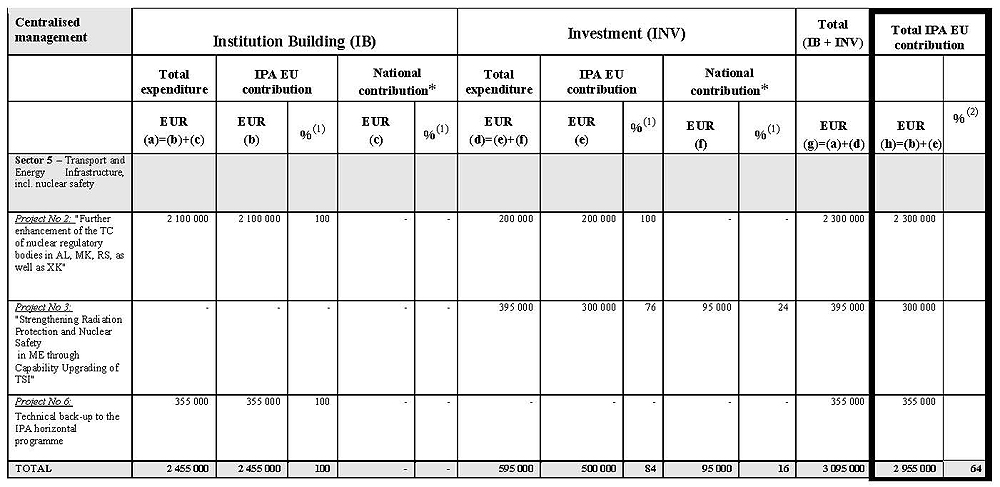
Amounts net of VAT
* contribution (public and private national and/or international contribution) provided by national counterparts
(1) Expressed in % of the Total expenditure IB or INV (column (a) or (d)).
(2) Sector rows only and for Centralised only. Expressed in % of the grand total of column (h). It indicates the relative weight of the sector with reference to the total IPA EU contribution of the entire FP.
3.a.c Table for decentralised projects

Amounts net of VAT
* public contribution (private contributions are not taken into account (Article 67(1) IPA IR) under decentralised management)
(1) Expressed in % of the Total expenditure IB or INV (column (a) or (d)).
(2) Sector rows only. Expressed in % of the grand total of column (h). It indicates the relative weight of the sector with reference to the total IPA EU contribution of the entire FP.
3.a.d Table summarising the IPA support according to the management mode adopted
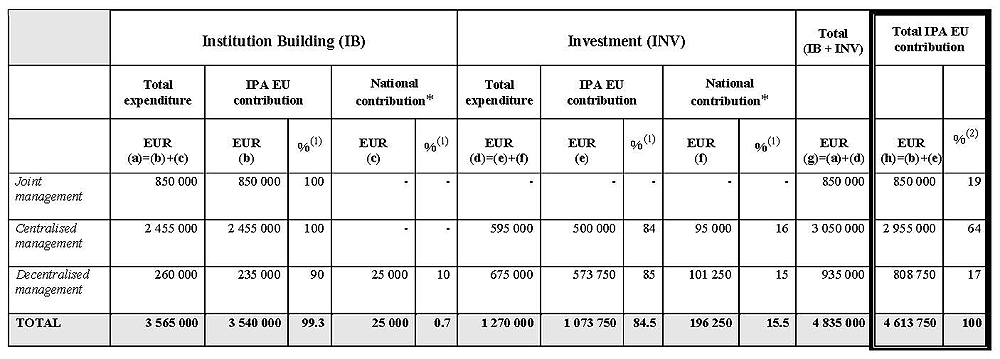
Amounts net of VAT
* contribution (public and private national and/or international contribution) provided by national counterparts for centralised management; public contribution (private contributions are not taken into account (Article 67(1) IPA IR) under decentralised management)
(1) Expressed in % of the Total expenditure IB or INV (column (a) or (d)).
(2) Expressed in % of the grand total of column (h)
3.b Principle of Co-Financing applying to the programme
For project No 1 in joint management with the IAEA, the IPA EU contribution represents 100% of the total budget allocated to this part of the programme. This has been calculated in relation to the eligible expenditure, which is based on the total expenditure. On account of its regional character, project No 1 is not co-financed.
For projects to be implemented by centralised management (projects No 2, 3 and 6) the IPA EU contribution represents 95% of the total budget allocated to this part of the programme. This has been calculated in relation to the eligible expenditure, which is based on the total expenditure. Parallel co-financing will be used. The requirements of co-financing for INV at project level have been complied with for project No 3. No co-financing is planned for project No 2 which is a regional project. Project No 6 refers to an administrative arrangement with the Joint Research Centre. No co-financing is required for this activity.
For projects to be implemented by decentralised management (projects No 4 and 5), the IPA EU contribution represents 86% of the total budget allocated to this part of the programme. This has been calculated in relation to the eligible expenditure, which is based on the public expenditure. Joint co-financing will be used as a rule. The requirements of co-financing for Institution Building (IB) and Investment (INV) at project level have been complied with.
4. IMPLEMENTATION
4.a Management modes and Implementation modalities
For project No 1, the programme will be implemented by the European Commission by joint management with the International Atomic Energy Agency following Article 53d of the Financial Regulation and the corresponding provisions of the Implementing Rules. To this end, the Commission and the IAEA will conclude one Contribution Agreement in accordance with the Financial and Administrative Framework Agreement (FAFA).
Joint management will be used to delegate implementation of tasks to international organisations. Only the IAEA is concerned by this management mode and it is currently subject to an assessment in relation to Article 53d of the Financial Regulation. In anticipation of the results of the assessment, the authorising officer deems that, based on the longstanding and problem free cooperation with the IAEA, joint management mode can be proposed and a Convention can be signed in accordance with the provisions laid down in Article 43 of the Implementing Rules to the Financial Regulation.
Projects No 2, 3 and 6 will be implemented on a centralised basis by the European Commission in accordance with Article 53a of the Financial Regulation and the corresponding provisions of the Implementing Rules.
Projects No 4 and 5 shall be implemented by decentralised management, in accordance with Article 53c of the Financial Regulation and the corresponding provisions of the Implementing Rules. The Beneficiary will continue to ensure that the conditions laid down in Article 56 of the Financial Regulation are respected at all times.
The ex-ante control by the European Commission shall apply to the tendering of contract, launch of call for proposals and the award of contracts and grants until the European Commission allows for decentralised management without ex-ante controls as referred in Article 18 of the IPA Implementing Regulation.
4.b General rules for procurement and grant award procedures
For project No 1, the general rules for procurement and grant award procedures shall be defined in the Contribution Agreements between the Commission and the IAEA implementing such programme/activity.
For projects No 2, No 3, No 4, No 5 and No 6 procurement shall follow the provisions of Part Two, Title IV of the Financial Regulation and Part Two, Title III, Chapter 3 of its Implementing Rules as well as the rules and procedures for service, supply and works contracts financed from the general budget of the European Union for the purposes of cooperation with third countries adopted by the Commission on 24 May 2007 (C (2007)2034).
Grant award procedures shall follow the provisions of Part One, Title VI of the Financial Regulation and Part One, Title VI of its Implementing Rules.
The Contracting authorities shall also use the procedural guidelines and standard templates and models facilitating the application of the above rules provided for in the «Practical Guide to contract procedures for EU external actions« («Practical Guide») as published on the DEVCO website at the date of the initiation of the procurement or grant award procedure.The essential selection and award criteria for the award of grants are laid down in the Practical Guide. The detailed selection and award criteria will be laid down in the Calls for proposals – Guidelines for applicants.
5. MONITORING AND EVALUATION
5.a Monitoring
The Commission may undertake any actions it deems necessary to monitor the programmes concerned and for the projects in joint management with IAEA these actions may be carried out jointly with the IAEA.
Decentralised projects will be monitored through the IPA Monitoring Committee assisted by Transition Assistance and Institution Building Monitoring Committee, and the Joint Monitoring Committee.
They shall assess the effectiveness, quality and coherence of the implementation of this programme. They may make proposals to the European Commission and the national IPA co-ordinator, with a copy to the national authorising officer, for decisions on any corrective measures to ensure the achievements of programme objectives and enhance the efficiency of the assistance provided.
5.b Evaluation
Programmes shall be subject to ex ante evaluations, as well as interim and, where relevant, ex post evaluations in accordance with Articles 57 and 82 of the IPA Implementing Regulation, with the aim of improving the quality, effectiveness and consistency of the assistance from EU funds and the strategy and implementation of the programmes.
For decentralised projects, after the conferral of management powers, the responsibility for carrying out interim evaluations shall lie with the Beneficiary, without the prejudice on the European Commission’s rights to perform any ad hoc interim evaluations of the programmes it deems necessary. Ex post evaluation shall remain a prerogative of the European Commission even after the conferral of management powers to the Beneficiary.
The results of evaluations shall be taken into account in the programming and implementation cycle.
The Commission may also carry out strategic evaluations.
6. AUDIT, FINANCIAL CONTROL, ANTIFRAUD MEASURES; FINANCIAL ADJUSTMENTS, PREVENTIVE MEASURES AND FINANCIAL CORRECTIONS
6.a Audit, Financial Control and Anti-fraud measures
The accounts and operations of all parties involved in the implementation of this programme, as well as all contracts and agreements implementing this programme, are subject to, on the one hand, the supervision and financial control by the European Commission (including the European Anti-Fraud Office), which may carry out checks at its discretion, either by itself or through an outside auditor and, on the other hand, audits by the European Court of Auditors. This includes measures such as ex-ante verification of tendering and contracting carried out by the EU Delegation in the Beneficiary.
In order to ensure the efficient protection of the financial interests of the European Union, the European Commission (including the European Anti-Fraud Office) may conduct on-the-spot checks and inspections in accordance with the procedures foreseen in Council Regulation (EC, Euratom) 2185/96.
The controls and audits described above are applicable to all contractors, subcontractors and grant beneficiaries who have received EU funds.
6.b Financial adjustments
For decentralised projects, the national authorising officer, who bears in the first instance the responsibility for investigating all irregularities, shall make the financial adjustments where irregularities or negligence are detected in connection with the implementation of this programme, by cancelling all or part of the EU assistance. The national authorising officer shall take into account the nature and gravity of the irregularities and the financial loss to the EU assistance.
In case of an irregularity, including negligence and fraud, the national authorising officer shall recover the EU assistance paid to the Beneficiary in accordance with national recovery procedures.
6.c Audit trail
For decentralised projects, the national authorising officer shall ensure that all the relevant information is available to ensure at all times a sufficiently detailed audit trail. This information shall include documentary evidence of the authorisation of payment applications, of the accounting and payment of such applications, and of the treatment of advances, guarantees and debts.
6.d Preventive Measures
For decentralised projects, Beneficiaries shall ensure investigation and effective treatment of suspected cases of fraud and irregularities and shall ensure the functioning of a control and reporting mechanism equivalent to that provided for in Commission Regulation 1828/2006. All suspected or actual cases of fraud and irregularity as well as all measures related thereto taken must be reported to the European Commission services without delay. Should there be no suspected or actual cases of fraud or irregularity to report, the Beneficiary shall inform the European Commission of this fact within two months following the end of each quarter.
Irregularity shall mean any infringement of a provision of applicable rules and contracts, resulting from an act or omission by an economic operator, which has, or would have, the effect of prejudicing the general budget of the European Union by charging an unjustified item of expenditure to the general budget.
Fraud shall mean any intentional act or omission relating to: the use or presentation of false, incorrect or incomplete statements or documents, which has as its effect the misappropriation or wrongful retention of funds from the general budget of the European Union or budgets managed by, or on behalf of, the European Union; non disclosure of information in violation of a specific obligation with the same effect; the misapplication of such funds for purposes other than those for which they are originally granted.
The Beneficiary shall take any appropriate measure to prevent and counter active and passive corruption practises at any stage of the procurement procedure or grant award procedure, as well as during the implementation of corresponding contracts.
Active corruption is defined as the deliberate action of whosoever promises or gives, directly or through an intermediary, an advantage of any kind whatsoever to an official for himself or for a third party for him to act or to refrain from acting in accordance with his duty or in the exercise of his functions in breach of his official duties in a way which damages or is likely to damage the European Union’s financial interests.
Passive corruption is defined as the deliberate action of an official, who, directly or through an intermediary, requests or receives advantages of any kind whatsoever, for himself or a third party, or accepts a promise of such advantage, to act or to refrain from acting in accordance with his duty or in the exercise of his functions in breach of his official duties in a way which damages or is likely to damage the European Union’s financial interests.
The authorities of the Beneficiary, including the personnel responsible for the implementation of the programme, shall also undertake to take whatever precautions are necessary to avoid any risk of conflict of interest, and shall inform the European Commission immediately of any such conflict of interest or any situation likely to give rise to any such conflict.
6.e Financial corrections
For decentralised projects, in order to ensure that the funds are used in accordance with the applicable rules, the European Commission shall apply clearance-of-accounts procedures or financial correction mechanisms in accordance with Article 53c (2) of the Financial Regulation and as detailed in the Framework Agreement concluded between the European Commission and the Beneficiary.
A financial correction may arise following:
(i) identification of a specific irregularity, including fraud; or
(ii) identification of a weakness or deficiency in the management and control systems of the Beneficiary;
If the European Commission finds that expenditure under this programme has been incurred in a way that has infringed applicable rules, it shall decide what amounts are to be excluded from EU financing.
The calculation and establishment of any such corrections, as well as the related recoveries, shall be made by the European Commission following the criteria and procedures provided for in the IPA Implementing Regulation.
7. NON SUBSTANTIAL REALLOCATION OF FUNDS
The authorising officer by delegation (AOD), or the authorising officer by sub-delegation (AOSD), in line with the delegation of powers conferred upon him/her by the AOD, in accordance with the principles of sound financial management, may undertake non substantial reallocations of funds without an amending financing decision being necessary. In this context, cumulative reallocations not exceeding 20% of the total amount allocated for the programme, subject to a limit of EUR 4 million, shall not be considered substantial, provided that they do not affect the nature and objectives of the programme. The IPA Committee shall be informed of the above reallocation of funds.
8. LIMITED CHANGES
Limited changes in the implementation of this programme affecting essential elements listed under Article 90 of the Implementing Rules to the Financial Regulation, which are of an indicative nature, may be undertaken by the authorising officer by delegation (AOD), or by the authorising officer by sub-delegation (AOSD), in line with the delegation of powers conferred upon him by the AOD, in accordance with the principles of sound financial management without an amending financing decision being necessary.
FRAMEWORK AGREEMENT BETWEEN THE GOVERNMENT OF THE REPUBLIC OF CROATIA AND THE COMMISSION OF THE EUROPEAN COMMUNITIES ON THE RULES FOR CO-OPERATION CONCERNING EC-FINANCIAL ASSISTANCE TO THE REPUBLIC OF CROATIA IN THE FRAMEWORK OF THE IMPLEMENTATION OF THE ASSISTANCE UNDER THE INSTRUMENT FOR PRE-ACCESSION ASSISTANCE (IPA)
DATED 27 AUGUST 2007
Annexes:
ANNEX A: Functions and common responsibilities of the structures, authorities and bodies in accordance with Article 8 of the Framework Agreement between the Commission and the Government of the Republic of Croatia of 27 August 2007
ANNEX B: Model Statement of Assurance of the national authorising officer in accordance with Article 17 of the Framework Agreement between the Commission and the Government of the Republic of Croatia of 27 August 2007
ANNEX C: Model Annual Audit Activity Report of the audit authority of the Republic of Croatia in accordance with Article 29(2)(b) of the IPA Implementing Regulation
ANNEX D: Model Annual Audit Opinion of the audit authority of the Republic of Croatia in accordance with Article 29(2)(b) of the IPA Implementing Regulation
ANNEX E: Model Audit Opinion of the audit authority of the Republic of Croatia on the final statement of expenditure for the closure of a programme or parts of a programme in accordance with Article 29(2)(b) of the IPA Implementing Regulation
The Commission of the European Communities, hereinafter referred to as «the Commission», acting for and on behalf of the European Community, hereinafter referred to as «the Community« on the one part,
and the Government of the Republic of Croatia, acting on behalf of the Republic of Croatia, hereinafter referred to as «the Beneficiary»
and together, jointly referred to as «the Contracting Parties»
Whereas
(1) On 1 August 2006, the Council of the European Union adopted Regulation (EC) No 1085/2006 of 17 July 2006() establishing an instrument for pre-accession assistance (hereinafter referred to as «IPA Framework Regulation»). With effect from the 1 January 2007, this new instrument constitutes the single legal basis for the provision of financial assistance to candidate countries and potential candidate countries in their efforts to enhance political, economic and institutional reforms with a view to become members of the European Union;
(2) On 12 June 2007, the Commission has adopted the regulation implementing the IPA Framework Regulation, detailing applicable management and control provisions;
(3) The new instrument for pre-accession assistance (IPA) replaces the five previously existing pre-accession instruments: Regulation (EEC) No 3906/1989 on economic aid to certain countries of Central and Eastern Europe, Regulation (EC) No 1267/1999 on the establishment of an instrument for structural policies for pre-accession, Regulation (EC) No 1268/1999 on the support for pre-accession measures for agriculture and rural development, Regulation (EC) No 2666/2000 on assistance for Albania, Bosnia and Herzegovina, Croatia, the Federal Republic of Yugoslavia and the Former Yugoslav Republic of Macedonia, repealing Regulation (EC) No 1628/96 and amending Regulations (EEC) No 3906/89 and (EEC) No 1360/90 and Decisions 97/256/EC and 1999/311/EC and Regulation (EC) No 2500/2001 on the financial assistance to Turkey;
(4) The Beneficiary is eligible under IPA as provided for in the IPA Framework Regulation and in Commission Regulation (EC) No 718/2007 of 12 June 2007() implementing the IPA Framework Regulation (hereinafter referred to as «IPA Implementing Regulation»);
(5) The Beneficiary figures in Annex I of the IPA Framework Regulation, and should therefore have access to the 5 components established under IPA, i.e. the Transition Assistance and Institution Building Component, the Cross-Border Co-operation Component, the Regional Development Component, the Human Resources Development Component and the Rural Development Component;
(6) It is therefore necessary to set out the rules for co-operation concerning EC financial assistance with the Beneficiary under IPA;
HAVE AGREED AS FOLLOWS:
SECTION I
GENERAL PROVISIONS
Article 1
INTERPRETATION
(1) Subject to any express provision to the contrary in this Framework Agreement, the terms used in this Agreement shall bear the same meaning as attributed to them in the IPA Framework Regulation and the IPA Implementing Regulation.
(2) Subject to any express provision to the contrary in this Framework Agreement, references to this Agreement are references to such Agreement as amended, supplemented or replaced from time to time.
(3) Any references to Council or Commission Regulations are made to the version of those regulations as indicated. If required, modifications of theses regulations shall be transposed into this Framework Agreement by means of amendments.
(4) Headings in this Agreement have no legal significance and do not affect its interpretation.
Article 2
PARTIAL INVALIDITY AND UNINTENTIONAL GAPS
If a provision of this Agreement is or becomes invalid or if this Agreement contains unintentional gaps, this will not affect the validity of the other provisions of this Agreement. The Contracting Parties will replace any invalid provision by a valid provision which comes as close as possible to the purpose of and intent of the invalid provision. The Contracting Parties will fill any unintentional gap by a provision which best suits the purpose and intent of this Agreement in compliance with the IPA Framework Regulation and the IPA Implementing Regulation.
Article 3
PURPOSE
(1) In order to promote co-operation between the Contracting Parties and to assist the Beneficiary in its progressive alignment with the standards and policies of the European Union, including, where appropriate the acquis communautaire, with a view to membership, the Contracting Parties agree to implement activities in the various fields as specified in the two regulations mentioned above and as applicable to the Beneficiary.
(2) The assistance activities shall be financed and implemented within the legal, administrative and technical framework laid down in this Agreement and as further detailed in Sectoral Agreements and/or Financing Agreements, if any.
(3) The Beneficiary takes all necessary steps in order to ensure the proper execution of all assistance activities and to facilitate the implementation of the related programmes.
Article 4
GENERAL RULES ON FINANCIAL ASSISTANCE
(1) The following principles shall apply to financial assistance by the Community under IPA:
a) Assistance shall respect the principles of coherence, complementarity, co-ordination, partnership and concentration;
b) Assistance shall be coherent with EU policies and shall support alignment to the acquis communautaire;
c) Assistance shall comply with the budgetary principles laid down in Council Regulation (EC, Euratom) No 1605/2002 of 25 June 2002() on the Financial Regulation applicable to the general budget of the European Communities (hereinafter referred to as «Financial Regulation») and its Implementing Rules();
d) Assistance shall be consistent with the needs identified in the enlargement process and absorption capacities of the Beneficiary. It shall also take account of lessons learned;
e) The ownership of the programming and implementation of assistance by the Beneficiary shall be strongly encouraged and adequate visibility of EU intervention shall be ensured;
f) Operations shall be properly prepared, with clear and verifiable objectives, which are to be achieved within a given period; the results obtained should be assessed through clearly measurable and adequate indicators;
g) Any discrimination based on sex, racial or ethnic origin, religion or belief, disability, age or sexual orientation shall be prevented during the various stages of the implementation of assistance;
h) The objectives of pre-accession assistance shall be pursued in the framework of sustainable development and the Community promotion of the goal of protecting and improving the environment.
(2) Assistance for the Beneficiary shall be based on the priorities identified in the existing documents, i.e. the European Partnership, the Accession partnership, the national programme for the adoption of the acquis communautaire, the reports and strategy paper contained in the annual enlargement package of the Commission, the Stabilisation and Association Agreement and the negotiation framework.
(3) All operations receiving assistance under IPA shall in principle require co-financing by the Beneficiary and the Community, unless otherwise agreed upon in a Sectoral Agreement or Financing Agreement.
(4) Where the execution of activities depends on financial commitments from the Beneficiary’s own resources or from other sources of funds, the funding of the Community shall become available at such time as the financial commitments of the Beneficiary and/or the other sources of funds themselves become available.
(5) The provision of Community financing under IPA shall be subject to the fulfilment by the Beneficiary’s obligations under this Framework Agreement and under Sectoral Agreements and Financing Agreements, if any.
Article 5
IMPLEMENTATION METHODS
(1) For the implementation of assistance under IPA in the Republic of Croatia, decentralised management, whereby the Commission confers the management of certain actions on the Beneficiary, while retaining overall final responsibility for general budget execution in accordance with Article 53c of the Financial Regulation and the relevant provisions of the EC Treaties, shall apply as a rule. Decentralised management shall cover at least tendering, contracting and payments by the national administration of the Beneficiary. Operations shall be implemented in accordance with the provisions laid down in Article 53c of the Financial Regulation and the ones referred to in this article.
(2) However, the Contracting Parties may agree to make use of
a) centralised management as defined in Article 53a of the Financial Regulation under the Transition Assistance and Institution Building Component, in particular for regional and horizontal programmes, and under the Cross-Border Co-operation Component. It may also be used for technical assistance under any of the IPA components. Operations shall be implemented in accordance with the provisions laid down in Articles 53 point (a), 53a and 54 to 57 of the Financial Regulation.
b) joint management as defined in Article 53d of the Financial Regulation for the Transition Assistance and Institution Building Component, in particular for regional and horizontal programmes, and for programmes involving international organisations. Operations shall be implemented in accordance with the provisions laid down in Articles 53 point (c) and 53d of the Financial Regulation.
c) shared management as defined in Article 53b of the Financial Regulation under the Cross-Border Co-operation Component, for cross-border programmes involving Member States of the European Union. Operations shall be implemented in accordance with the provisions laid down in Articles 53 point (b), 53b and Title II of Part two of the Financial Regulation. The following particular provision shall be taken into account in the implementation of cross-border programmes with Member States.
Where one or more Member States of the European Union and the Beneficiary participating in a cross-border programme are not yet ready for implementation of the whole programme under shared management, the part of the programme concerning the Member State(s) shall be implemented in accordance with Title II (Cross-Border Co-operation Component), Chapter III, Section 2 of the IPA Implementing Regulation (Articles 101 to 138) and the part of the programme concerning the Beneficiary shall be implemented in accordance with Title II, Chapter III, Section 3 of the IPA Implementing Regulation. (Articles 139 to 146 IPA Implementing Regulation, with the exception of Article 142. The provisions concerning the joint monitoring committee of Article 110 shall apply).
(3) If required by the related Financing Decision, the Commission and the Beneficiary shall conclude a Financing Agreement in accordance with Article 8 of the IPA Implementing Regulation on multi-annual or annual programmes. Financing Agreements may be concluded between the Commission and several beneficiary countries under IPA including the Beneficiary for assistance for multi-country programmes and horizontal initiatives.
(4) This Framework Agreement shall apply to all Financing Agreements concluded between the Contracting Parties for the financial assistance under IPA. Where they exist, Sectoral Agreements related to a given component shall apply to all Financing Agreements concluded under that component. Where there is no Financing Agreement, the rules included in this Framework Agreement apply together with Sectoral Agreements, if any.
Section II
MANAGEMENT STRUCTURES AND AUTHORITIES
Article 6
ESTABLISHMENT AND DESIGNATION OF STRUCTURES AND AUTHORITIES FOR DECENTRALIZED MANAGEMENT
(1) The following structures and authorities must be designated by the Beneficiary in the event of decentralised management:
a) The competent accrediting officer (CAO);
b) The national IPA co-ordinator (NIPAC);
c) The strategic coordinator for the Regional Development Component and the Human Resources Development Component;
d) The national authorising officer (NAO);
e) The national fund (NF);
f) Operating structures per component or programme to deal with the management and implementation of assistance under the IPA Regulation;
g) The audit authority.
(2) Specific bodies may be established within the overall framework defined by the bodies and authorities described above within or outside the operating structures initially designated. The Beneficiary shall ensure that the final responsibility for the functions of operating structures shall remain with the operating structure initially designated. Such a restructuring shall be formalised in written agreements or governmental acts and shall be subject to accreditation by the national authorising officer and the conferral of management by the Commission.
(3) The Beneficiary shall ensure that appropriate segregation of duties applies to the bodies and authorities mentioned under paragraph 1 and 2 above in accordance with Article 56 of the Financial Regulation. Duties are segregated when different tasks related to a transaction are allocated to different staff, thereby helping to ensure that each separate task has been properly undertaken.
Article 7
ESTABLISHMENT AND DESIGNATION OF STRUCTURES AND AUTHORITIES FOR CENTRALIZED OR JOINT MANAGEMENT
(1) In the event of centralised or joint management the national IPA co-ordinator shall act as the representative of the Beneficiary vis-ŕ-vis the Commission. He shall ensure that a close link is maintained between the Commission and the Beneficiary with regard both to the general accession process and to EU pre-accession assistance under IPA.
(2) The national IPA co-ordinator shall also be responsible for co-ordinating the Beneficiary’s participation in the relevant cross-border programmes, both with Member States and with other Beneficiary countries, as well as in the trans-national, interregional or sea basins programmes under other Community instruments. He may delegate the tasks relating to this latter responsibility to a cross-border co-operation co-ordinator.
(3) In the case of the Cross-border Co-operation Component, operating structures shall be designated and put in place by the Beneficiary, in accordance with Article 139 of the IPA Implementing Regulation.
Article 8
FUNCTIONS AND COMMON RESPONSIBILITIES OF THE STRUCTURES, AUTHORITIES AND BODIES
(1) The bodies and authorities mentioned in Article 6 above shall be allocated the functions and common responsibilities as set out in ANNEX A to this Framework Agreement.
(2) Component-related specific allocations of functions and responsibilities may be set out in Sectoral Agreements or Financing Agreements. They must not be in contradiction to the basic approach chosen for the allocation of functions and common responsibilities as shown in ANNEX A.
(3) Where under decentralised management specific persons have been given responsibility for an activity in relation to the management, implementation and control of programmes, the Beneficiary shall enable such persons to exercise the duties associated with that responsibility including in cases where, there is no hierarchical link between them and the bodies participating in that activity. The Beneficiary shall, in particular, provide those persons with the authority to establish, through formal working arrangements between them and the bodies concerned:
a) an appropriate system for the exchange of information, including the power to require information and a right of access to documents and staff on the spot, if necessary;
b) the standards to be met;
c) the procedures to be followed.
Section III
ACCREDITATION AND CONFERRAL OF MANAGEMENT POWERS UNDER DECENTRALISED MANAGEMENT
Article 9
COMMON REQUIREMENTS
Management relating to a component, a programme or a measure can only be conferred on the Republic of Croatia, if and when the following requirements are fulfilled:
a) The Beneficiary meets the conditions set to Article 56 of the Financial Regulation, in particular as regards the management and control systems. The management and control systems set up in the Republic of Croatia shall provide for effective and efficient control in at least the areas set out in the Annex to the IPA Implementing Regulation and as listed under No 1 c) of ANNEX A to this Framework Agreement. The Contracting Parties may define further provisions in Sectoral Agreements or Financing Agreements.
b) The competent accrediting officer has given accreditation to the national authorising officer both
• as the head of the national fund bearing overall responsibility for the financial management of EU funds in the Republic of Croatia and being responsible for the legality and regularity of the underlying transactions;
• with regard to national authorising officer’s capacity to fulfil the responsibilities for the effective functioning of management and control systems under IPA.
The accreditation of the national authorising officer shall also cover the national fund as described in Annex A, 5.
c) The national authorising officer has given accreditation to the relevant operating structures.
Article 10
PROCEDURE FOR ACCREDITATION OF THE NATIONAL AUTHORIZING OFFICER AND THE NATIONAL FUND BY THE COMPETENT ACCREDITING OFFICER
(1) Accreditation of the national authorising officer in accordance with Article 11 of the IPA Implementing Regulation is subject to his fulfilment of the applicable requirements set out in Article 11 of the said regulation and as further defined in Annex A, 4. This accreditation shall be supported by an audit opinion drawn up by an external auditor functionally independent from all actors in the management and control system. The audit opinion shall be based on examinations conducted according to internationally accepted auditing standards.
(2) The competent accrediting officer shall notify the Commission of the accreditation of the national authorising officer, not later than the notification of the accreditation of the first operating structure. The competent accrediting officer shall provide all relevant supporting information required by the Commission.
(3) The competent accrediting officer shall immediately inform the Commission of any changes concerning the national authorising officer or the national fund. Where a change affects the national authorising officer or the national fund in relation to the applicable requirements as set out in Article 11 of the IPA Implementing Regulation, the competent accrediting officer shall send to the Commission an assessment of the consequences of such a change on the validity of the accreditation. Where such a change is significant, the competent accrediting officer shall also notify the Commission of his decision concerning the accreditation.
Article 11
PROCEDURE FOR ACCREDITATION OF OPERATING STRUCTURE BY THE NATIONAL AUTHORIZING OFFICER
(1) Accreditation of an operating structure is subject to its fulfilment of the requirements set out in Article 11 of the IPA Implementing Regulation. This assurance shall be supported by an audit opinion drawn up by an external auditor functionally independent from all actors in the management and control system. The audit opinion shall be based on examinations conducted according to internationally accepted auditing standards.
(2) The national authorising officer shall notify the Commission of the accreditation of the operating structures and shall provide all relevant supporting information required by the Commission, including a description of the management and control systems.
Article 12
PROCEDURE FOR CONFERRAL OF MANAGEMENT POWERS BY THE COMMISSION
(1) The Commission shall confer management powers on the Beneficiary, only after the bodies and authorities referred to in Article 6 above have been designated and put in place and the conditions laid down in this article are fulfilled.
(2) Before the conferral of management powers, the Commission shall review the accreditations of the national authorising officer and the operating structures as laid down in Articles 10 and 11 above and examine the procedures and structures of any of the bodies or authorities concerned within the Republic of Croatia. This may include on-the-spot verifications by the services of the Commissions or subcontracted to an audit firm.
(3) The Commission may, in its decision to confer management powers, set further conditions, with a view to ensuring that the requirements referred to in Article 11 of the IPA Implementing Regulation are met. These further conditions must be fulfilled within a fixed period determined by the Commission for the conferral of management powers to remain effective.
(4) The Commission Decision on the conferral of management powers shall lay down the list of the ex ante controls, if any, to be performed by the Commission on the tendering of contracts, launch of calls for proposals and the award of contracts and grants. This list may vary with the component or the programme. The ex ante controls shall apply, depending on the component or programme, until the Commission allows for decentralised management without ex ante controls as referred to in Article 16 below.
Article 13
WITHDRAWAL OR SUSPENSION OF THE ACCREDITATION OF THE NATIONAL AUTHORISING OFFICER AND THE NATIONAL FUND
(1) After the conferral of management powers by the Commission, the competent accrediting officer shall be responsible for monitoring the continuing fulfilment of all the requirements for this accreditation to be maintained and shall inform the Commission of any significant change related thereto.
(2) If any of the applicable requirements set out in Article 11 of the IPA Implementing Regulation, are not, or are no longer, fulfilled, the competent accrediting officer shall either suspend or withdraw the accreditation of the national authorising officer, and shall immediately inform the Commission of his decision and of the reasons for his decision. The competent accrediting officer shall assure himself that those requirements are again fulfilled before restoring the accreditation. This assurance shall be supported by an audit opinion as specified in Article 10(1) above.
(3) Where the accreditation of the national authorising officer is withdrawn or suspended by the competent accrediting officer, the following provisions shall apply:
• The Commission shall cease to make transfers of funds to the Beneficiary during the period when the accreditation is not in force;
• During the period when the accreditation is not in force, all the euro accounts or the euro accounts for the components concerned shall be blocked and no payment made by the National Fund from those euros accounts which are blocked shall be considered eligible for Community funding;
• Without prejudice to any other financial corrections, the Commission may make financial corrections as laid down in Article 30 below against the Beneficiary in respect of its past non-compliance with the requirements for the conferral of management powers.
Article 14
WITHDRAWAL OR SUSPENSION OF THE ACCREDITATION OF THE OPERATING STRUCTURES
(1) After the conferral of management powers by the Commission, the national authorising officer shall be responsible for monitoring the continuing fulfilment of all the requirements for this accreditation to be maintained and shall inform the Commission and the competent accrediting officer of any significant change related thereto.
(2) If any of the requirements set out in Article 11 of the IPA Implementing Regulation are not, or are no longer, fulfilled, the national authorising officer shall either suspend or withdraw the accreditation of the operating structure concerned, and shall immediately inform the Commission and the competent accrediting officer of his decision and of the reasons for his decision.
The national authorising officer shall assure himself that those requirements are again fulfilled before restoring the accreditation concerned. This assurance shall be supported by an audit opinion as referred to in Article 11(1) above.
(3) Where the accreditation of an operating structure is withdrawn or suspended by the national authorising officer, the following provisions shall apply.
• The Commission shall make no transfers to the Beneficiary of funds relating to programmes or operations implemented by the operating structure concerned while its accreditation is suspended or withdrawn;
• Without prejudice to any other financial corrections, the Commission may make financial corrections as laid down in Article 30 below against the Beneficiary in respect of its past non-compliance with the requirements and conditions for the conferral of management powers;
• No new legal commitments made by the operating structure concerned shall be considered eligible during the period when the accreditation is not in force;
• The national authorising officer shall be responsible for taking any appropriate safeguard measures regarding payments made or contracts signed by the operating structure concerned.
Article 15
WITHDRAWAL OR SUSPENSION OF THE ACCREDITATION OF MANAGEMENT POWERS
(1) The Commission shall monitor compliance with the requirements set out in Article 11 of the IPA Implementing Regulation.
(2) Irrespective of the decision by the competent accrediting officer to maintain, suspend or withdraw the accreditation of the national authorising officer, or of the decision by the national authorising officer to maintain, suspend or withdraw the accreditation of the operating structure, the Commission may withdraw or suspend the conferral of management powers at any time, in particular in the event that any of the requirements mentioned in Article 11 of the IPA Implementing Regulation are not, or no longer, fulfilled.
(3) Where the conferral of management powers is withdrawn or suspended by the Commission, the following provisions shall apply:
• The Commission shall cease to make transfers of funds to the Beneficiary;
• Without prejudice to any other financial corrections, the Commission may make financial corrections as laid down in Article 30 below against the Beneficiary in respect of its past non-compliance with the requirements for the conferral of management powers.
The Commission may lay down other consequences of such a suspension or withdrawal in a specific Commission Decision
(4) The Commission Decision may lay down provisions concerning the suspension or withdrawal of the conferral of management powers in relation to specific bodies or authorities.
Article 16
DECENTRALIZATION WITHOUT EX-ANTE CONTROL BY THE COMMISSION
(1) Decentralisation without ex-ante control by the Commission shall be the objective for the implementation of all IPA components where assistance is implemented on a decentralised basis in accordance with Article 5 above. The timing for attainment of this objective may vary depending on the IPA Component concerned.
(2) Before dispensing with the ex-ante controls laid down in the Commission Decision on conferral of management, the Commission shall satisfy itself of the effective functioning of the management and control system concerned in accordance with the relevant Community and national rules. In particular, the Commission shall monitor the implementation, by the Beneficiary, of the roadmap included in the Financing Agreement, which may refer to a phased waiver of different types of ex-ante controls. The Commission shall take due account of the results achieved by the Beneficiary in this context, in particular in the provision of assistance and in the negotiation process.
Article 17
STATEMENT OF ASSURANCE BY THE NATIONAL AUTHORIZING OFFICER
(1) The national authorising officer shall make an annual management declaration covering
• his overall responsibility, in his function as head of the national fund, for the financial management of EU funds in the Republic of Croatia and for the legality and regularity of the underlying transactions;
• his responsibility for the effective functioning of management and control systems under IPA.
This management declaration shall take the form of a statement of assurance to be presented to the Commission by 28 February each year with a copy to the competent accrediting officer.
(2) The Statement of Assurance shall be based on the national authorising officer’s actual supervision of the management and control system throughout the financial year.
(3) The Statement of Assurance shall be drawn up according to the model attached in ANNEX B to this Framework Agreement.
(4) If the confirmations regarding the effective functioning of the management and control systems and the legality and regularity of underlying transactions required through the Statement of Assurance are not available, the national authorising officer shall inform the Commission, copy to the competent accrediting officer, of the reasons and potential consequences as well as of the actions being taken to remedy the situation and to protect the interests of the Community.
Article 18
ESTABLISHMENT OF REPOTS AND OPINIONS BY THE AUDIT AUTHORITY AND FOLLOW UP BY THE NATIONAL AUTHORIZING OFFICER AND THE COMMISSION
(1) Subject to the detailed functions and responsibilities of the audit authority as set out ANNEX A to this Framework Agreement, the audit authority shall in particular establish the following reports and opinions:

